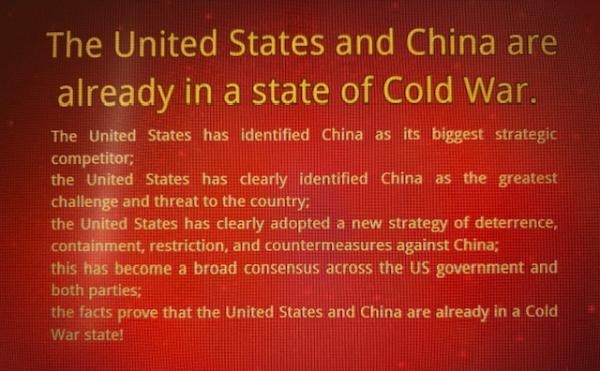
The United States and China are already in a state of Cold War.
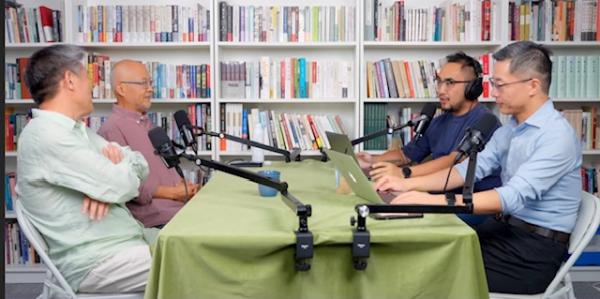
Irecently watched a video interview with Professor Wu Guoguang and the"Three Water Gunmen." The topic of the interview was: Has the US andChina entered a new Cold War? In the interview, Professor Wu Guoguang statedthat he does not agree with the view that the US and China have entered a newCold War, and believes that the Cold War is not entirely the same as thecurrent situation in essence, and does not yet possess the following twocharacteristics: First, the two camps of the Cold Warwere primarily opposed in terms of ideology and political system; the UnitedStates does not currently regard China as an adversary in terms of ideology andpolitical system. Second, for the Cold War to form two camps, it is quiteevident that authoritarian regimes led by the CCP have begun to band together,but the United States has not yet formed a clear political alliance with otherdemocratic countries. These two points prove that the Cold War does not yetpossess the basic characteristics of the Cold War.
An interview with ProfessorWu Guoguang and the "Three Water Gunmen" (video screenshot)
ProfessorWu Guoguang is a renowned political scientist, and his views are representativeto a certain extent. The US-China relationship influences the global politicallandscape, relates to world security and stability, and is crucial to thefuture political development of Chinese society. Therefore, a correctunderstanding of the US-China relationship is of great political significance.I would like to take this opportunity to clarify my own views and discuss themwith Professor Wu Guoguang:
Todiscuss the Cold War, we must first clarify its concept. What exactly is theCold War? According to internet explanations, the Cold War is a general termfor all hostile actions other than direct military combat. The nature of theCold War is characterized by tense, severely antagonistic, and confrontationalrelations between the two sides. Its methods and means include: propagandawarfare, infiltration and subversion, blockades and sanctions, arms races,peaceful evolution, proxy wars, and all other methods other than directmilitary combat.
Secondly,the Cold War was not defined by public declarations, but rather by theexistence of a fact and a state of affairs. Just like the two World Wars andthe Cold War between the US and the Soviet Union, neither side declared warbeforehand; rather, objective facts proved that they were already in a state ofconflict.
Furthermore,the Cold War was a bilateral conflict, a mutual confrontation, which couldoccur between two countries or between two political blocs.
Therefore,based on the nature and definition of the Cold War, and based on the currentpolitical, economic, and diplomatic situation between the United States andChina, I believe that Professor Wu Guoguang's two basic characteristics—thatthe United States and China have not entered a new Cold War, and that theUnited States does not regard China as an opponent in terms of ideology andpolitical system, and that the United States has not yet formed a clearpolitical alliance with other democratic countries—are both untenable.
Lü Honglai: The UnitedStates and China are already in a state of Cold War.
First,the fundamental ideological and political opposition between the United Statesand China is an objective fact known to all. The CCP's long-standingsubversion, infiltration, sabotage, intellectual property theft, and drugexport that harms American society are undeniable facts and constitute China'sCold War tactics against the United States. The reason people haven't clearlyfelt a Cold War between the US and China over the past thirty years is becausethe Western democratic camp, led by the United States, implemented a strategyof using economic integration to facilitate China's political transformation.However, this strategy has clearly failed, but this absolutely does not meanthat there was no Cold War between the US and China.
Second,the United States has long formed political alliances with other Westerndemocracies, such as NATO, the US-Japan-South Korea alliance, and alliancesbetween the United States and other Asia-Pacific countries, such as the US-NewZealand-Ottoman alliance, the US-Philippines alliance, and the US-Taiwanalliance. These military and political alliances are based on political systemsand ideologies and will not change due to changes in any specific policy.
Third,due to the failure of its strategy to facilitate China's politicaltransformation through economic integration, the United States has recentlyreadjusted its strategy towards China, designating China as its biggeststrategic competitor and adopting a new strategy of deterrence, containment,restriction, and countermeasures. One can examine the series of bills targetingChina passed by the US Senate and House of Representatives in the past twoyears:
**Taiwan Assurance Implementation Act*
**Strategic Territorial Intelligence and Law Enforcement to Counter the CCP Act*
*TechnologyTransfer Controls with China Act of 2025*
*ProtectingU.S. Innovation and Economic Security from the CCP Act of 2024*
*Counteringthe CCP's Drones Act*
*EndingChina's Dominance in U.S. Electric Vehicles Act*
*Helpingto Frustrate China Through Foreign Investment Assurance Act*
*U.S.Artificial Intelligence and China Decoupling Act*
Thesebills, which are clearly aimed at, prevent, and counter the Chinese CommunistParty regime, constitute the United States' Cold War against China.
Fourth,especially in its policy toward China, the strengthening of strategiccompetition, the safeguarding of core U.S. interests, the containment of theCCP's expansion, and the view of China as the U.S.'s biggest competitor and thegreatest challenge and threat to the U.S. have become a broad consensus acrossthe U.S. government and both parties. This demonstrates that a Cold War betweenthe U.S. and China has become a broad consensus across the U.S. governmentand both parties, and it is not something that any individual can influence orchange.
Fifth,the US-China trade war has far exceeded the scope of the two countries and hasbecome an international economic war to contain China. Currently, all tradeagreements signed by the US government with various countries include poisonpill clauses to prevent the re-export of Chinese products and the laundering ofcountry of origin. This means that all countries maintaining normal traderelations with the US have formed a united front to jointly prevent and containChina in international trade. What else is this but the Cold War?!
Sixth,just as I was preparing to write this article, the United States released the2025 National Security Strategy report. The National Security Strategy reportclearly states that the United States is focusing on the Western Hemisphere,which is considered to be a core area of U.S. interests, as well asthe Indo-Pacific region, especially the Taiwan issue.
RegardingChina and Taiwan, the 2025 National Security Strategy criticizes successiveU.S. administrations for attempting to integrate China into the rules-basedinternational order. The new strategy identifies China as a major economic andtechnological competitor and a potential military challenger, demanding thatallies increase their investment and actively participate in collectivedefense, focusing their efforts on countering China's "predatory economicbehavior" and avoiding direct military conflict through deterrence. Thisis tantamount to the U.S. openly declaring a new Cold War against the CCPregime!
ProfessorWu Guoguang reached the above conclusion primarily because, based on theinterview, he misunderstood some of the Trump administration's foreign policyand measures, overlooking the fact that the US government operates on aseparation of powers. It should be pointed out that the Cold War was notinitiated by anyone, but rather an inevitable consequence of two diametricallyopposed ideologies and political systems being unable to coexist peacefullywhile simultaneously trying to avoid hot war.
Oncethe CCP's party-state system was established, it meant that the CCP had chosento oppose human civilization, and it also meant the beginning of a cold warwith the civilized world. However, due to strategic needs of both sides duringa certain period of history, and the CCP's forced choice to reform and open upand to bide its time, this ideological and political conflict was eased.
Withoutchanges to China's political system, genuine friendship between the US andChina is impossible. The 40 years of reform and opening up have come to an end,and the strategic needs of both sides have long since disappeared, making anopen Cold War inevitable. The Cold War is not something declared by anyone; itis a reality, a real contest and game between two ideologies, two values, andtwo political systems. Today, the question is no longer whether a Cold Warexists between the US and China, but whether it will escalate further, and whatthe ultimate outcome of this zero-sum game will be.
Lu Honglai,
Monday, December 8, 2025
[]
_________________ 民主不仅仅是一种制度、一种思想,而且是一种生活方式!
Last edited by laolv on 2025-12-09 04:36; edited 1 time in total
You cannot post new topics in this forum You cannot reply to topics in this forum You cannot edit your posts in this forum You cannot delete your posts in this forum You cannot vote in polls in this forum You cannot attach files in this forum You can download files in this forum


 Global Announcement:

 :
:

 Jump to: